Somewhere on your list of priorities sits a line item called “real-time reporting.” It has been there so long it has earned seniority. It has outlasted two ERP updates, the advent of AI, and perhaps at least one person who swore this was the year.
If that sounds familiar, here is the reassuring part: waiting was a perfectly reasonable call. The quotes were huge, the timelines were protracted, and you had a business to run.
Here is the upside: the math and the timeline have changed in your favor.
The Good News Behind the Budget
The costly part of business intelligence was never the dashboard. It was the plumbing underneath: hand-coding pipelines that pull data from multiple systems — then clean it, model it, and load it into a central warehouse. That work was slow, specialized, and billed accordingly.
In 2026, AI-assisted data architecture has taken a big bite out of that tedious work. Automation in code|table|model production & validation in development and testing means the road to your first enterprise-grade BI dashboard is measured in weeks instead of seasons.
The problem business intelligence solves is still very much around, and plenty of businesses are looking to tackle it:
87%
of organizations struggle with disconnected data sources
Gartner, via Bizdata360, 2026
73%
of SMB distribution and retail leaders name data inconsistency from fragmented systems as their #1 challenge
Priority Software, 2025
You are in very good company. Better still, the fix is more within reach than it has ever been before.
Five Friendly Questions to Ask Before You Choose
Companies get to business intelligence in about seven different ways, ranging from “keep doing what we’re doing” to “build a team.” Answer these five questions about your own business and the right fit becomes an axiomatic reveal.
1. Where does the data behind your question(s) live?
Pick a question you wish you could answer in seconds: net margin by customer, say. Now count the systems that hold the pieces. SMBs run an average of 9 cloud tools (Mordor Intelligence, 2026), and only 27% have one solution that ties finance, inventory, and operations together (Priority Software, 2025). If everything you need sits in one system, its built-in reports may do the job nicely. If the answer is scattered across your ERP, accounting, and CRM, that is a sign you are a pipeline candidate.
2. What happens if your data analyst wins the lottery?
We would celebrate with them. But it is worth knowing what happens to your reporting the Monday after. A single hire or contractor can carry a lot of logic in their head and personal files. Look for a setup where everything is documented, portable, and belongs to you.
3. Is your history going somewhere safe?
Chat-with-your-data tools and forecasting get smarter when they can read your back catalog. Some self-serve platforms keep only 12–24 months of history, and spreadsheets overwrite data as they go. A governed warehouse keeps it all, so the data you collect becomes institutional knowledge.
4. What does the whole journey cost, not just the ticket?
Think of it like airfare: the ticket price is only part of the trip. Software licenses are the smallest piece of a BI effort. Staff time, rework, and the second analyst you hire when the first approach stalls (it happens) — these are where the real costs hide. Here is how the paths compare on the full trip:
| Path | Realistic cost | Time to first dashboard |
|---|---|---|
| Full-time in-house analyst | $145K–$165K+ per year, fully loaded | 2–4 months to hire, then ramp-up |
| Enterprise BI licenses + existing staff | $170–$290 per user per year, plus staff time | Weeks to never |
| Freelance consultant | Up to $50K per project | 3–6 months |
| Boutique agency | $55K–$250K per project | 2–4 months |
| Managed BI team | Custom-quoted, from $17K | 3–5 weeks |
| Spreadsheets and native reports | $0 direct, plus the staff hours behind them | Immediate |
Source: Mozzart BI Decision Guide, 2026, drawn from vendor pricing pages and third-party market-rate ranges.
5. What could one more year of momentum be worth?
Your spreadsheets have been loyal employees, and they deserve a good send-off. But the competition around you is moving ahead. 82% of organizations planned to increase BI and analytics funding in 2025 (Edvantis, 2025), and 91% of SMBs using AI say it directly boosts their revenue (Salesforce SMB Trends Report, 2024). Both of those wins run on connected data, and connected data is something you can start building this quarter.
The goal was never to buy business intelligence to keep pace with the competition. It was to have confidence in what your own numbers were trying to say. Sometimes a good spreadsheet gets you there, and sometimes it is time for something built to do the job.
Finding Your Fit
Once you have your five answers, the right path usually shows itself. Here is how it tends to shake out:
If your reporting is all about marketing and ad channels, a self-serve dashboard tool (roughly $600–$8,400+ a year) is quick, affordable, and built for exactly that.
If you have one well-defined dashboard and clean source data, a freelance consultant is a fast and friendly route to that one thing.
If you have a skilled data person with real bandwidth and modest needs, licensing an enterprise BI platform and building in-house can work well, as long as the scope stays focused.
If your data spans several real systems, your needs keep growing, and you would rather not add staff or a single point of failure, a managed team is built for you. Organizations with 1,000+ employees lean toward an in-house team, locked-in with the headcount AI can now supplant — more than 90% already have.
One Clear Picture
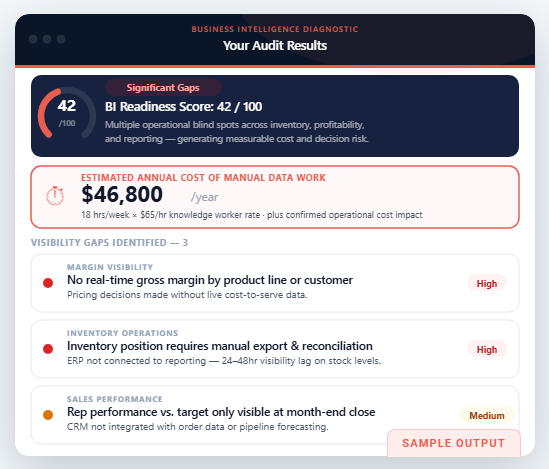
Here is a nice way to begin. Skip the vendor comparison for a moment. Consider the impact on your operation. This BI self-analysis tool will surface blind spots, manual reporting costs, risk, and generate a detailed strategy report.
You’ll see how the implications cut across daily decisions, for the entire team.
2026 came with a host of surprises. AI advances are a fast-moving rising-tide, with the potential to lift all boats. If 2027 is the year “someday” gets a date on the calendar, you could not have chosen a better moment. The budget, timing, and tools are all in your favor.